
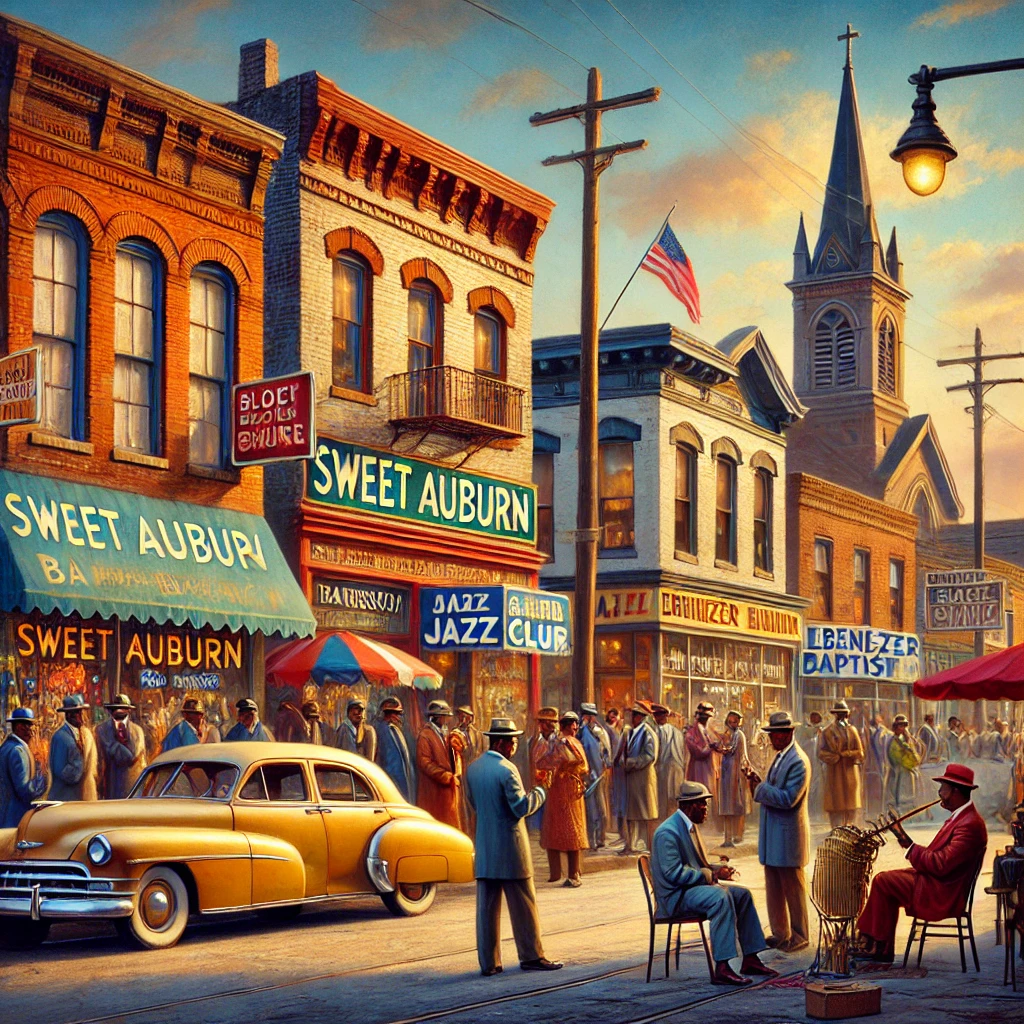
Sweet Auburn Avenue Atlanta Black History began as a compact corridor of power: in the mid-20th century it held more than 140 Black-owned businesses and drew national praise as “the richest Negro street in the world.”
The street, renamed from Wheat Street in 1893 and less than two miles east of Peachtree Street, acted as the commercial and spiritual center for African American life in the city. Major institutions such as Atlanta Life Insurance Company and Ebenezer Baptist Church anchored daily life and civic work.

The corridor later earned national historic landmark status in 1976 and contains the Martin Luther King Jr. birth home at 501 Auburn Avenue. This introduction previews how the neighborhood’s finance, faith, media, and entertainment sectors shaped civil rights leadership and community resilience. For a deeper source on these facts, see the Sweet Auburn legacy.
Key Takeaways
- Less than two miles from Peachtree Street, this street was Atlanta’s pre-civil rights epicenter for Black enterprise and worship.
- Fortune’s 1956 praise and the 1976 historic landmark status cemented its national significance.
- Major institutions—insurance, banks, churches, and markets—supported a dense network of businesses and civic life.
- The Martin Luther King Jr. birth home and local churches tied the corridor to civil rights leadership.
- Subsequent sections will trace origins, rise, challenges, and preservation efforts for the district.
Sweet Auburn Avenue Atlanta Black History: Origins, Significance, And Neighborhood Context
The 1893 renaming from Wheat Street helped trigger a spatial shift that concentrated commerce and civic life along this corridor. Under Jim Crow laws, many african americans clustered between downtown and the Atlanta University area, creating a resilient neighborhood within the Old Fourth Ward.
John Wesley Dobbs gave the street its celebrated nickname, and mid-century recognition followed. Fortune called it “the richest negro street in the world” after the corridor became a dense hub of firms, churches, and markets.
The “Richest Negro Street In The World” And Its Place In The Old Fourth Ward
The 1906 race riot accelerated a cautious migration of businesses to this street for safety and solidarity. The Sweet Auburn historic district later earned National Historic Landmark status and covers about 19 acres. Its boundaries tie the corridor to Freedom Parkway, the MARTA line, and the Downtown Connector.
“the richest negro street in the world”
Neighborhood strengths—proximity to rail, downtown, and the Atlanta University Center—supported sustained growth. Yet physical isolation and later highway projects exposed vulnerabilities that would test the district’s vitality and civil rights-era organizing.
| Year | Event | Effect | Location |
|---|---|---|---|
| 1893 | Wheat Street renamed | Boosted commercial identity | Old Fourth Ward |
| 1906 | Atlanta Race Riot | Businesses clustered for safety | Corridor west of original sites |
| 1956 | Fortune recognition | National acclaim as richest negro street | Commercial corridor |
| 1976 | Historic district designation | Preservation framework established | 19-acre landmark |
For detailed archival context, see the Auburn Avenue exhibit. For modern parallels, explore the rise of modern Black Wall Streets.
Rise, Resilience, And Reckoning: How Auburn Avenue Became A National Center Of Black Enterprise
auburn avenue rose quickly in the early 1900s as a concentrated hub where excluded residents built parallel institutions.
From Wheat Street to Sweet Auburn, Jim Crow boundaries funneled capital and talent into a compact corridor. Local entrepreneurs filled gaps left by white lenders and formed firms that served community needs.
From Wheat Street To Sweet Auburn: Naming, Jim Crow Boundaries, And Early Growth
Alonzo Herndon founded atlanta life insurance in 1905 after building wealth as a barber. Heman Perry opened Standard Life in 1911. Citizens Trust Bank followed, expanding access to mortgages and credit.
Black Finance’s “Three-Legged Stool”: Atlanta Life Insurance, Standard Life, And Citizens Trust Bank
Historian Gary Pomerantz called these firms the city’s “three-legged stool of Black finance.” Together they underwrote businesses, supported home ownership, and strengthened the emerging black middle class.
John Wesley Dobbs, Civic Power, And The Making Of A Black Middle Class
john wesley dobbs linked commerce to civic action. His organizing boosted voting access and municipal influence for professionals and shop owners.
Churches, Media, And Nightlife: Ebenezer Baptist, Big Bethel, Atlanta Daily World, And The Royal Peacock
Faith institutions and the atlanta daily world informed and mobilized the corridor. Venues like the Top Hat and Royal Peacock kept cultural life vibrant and drew talent from across the region.
Fortune’s 1956 Acclaim, Urban Change, And Decline Amid Integration And The Downtown Connector
Fortune’s 1956 label as the richest negro street amplified national attention. Yet integration and the Downtown Connector later diverted customers and capital, starting a long period of disinvestment.

- Financial backbone: Life insurance and banks supplied local loans and business finance.
- Civic leadership: Local figures tied economic power to voter and municipal gains.
- Culture and commerce: Newspapers, churches, and nightlife sustained a resilient economy.
| Institution | Founded | Primary Role | Impact |
|---|---|---|---|
| Atlanta Life Insurance | 1905 | Life insurance company | Capital for families and entrepreneurs |
| Standard Life | 1911 | Insurance company | Expanded policy access |
| Citizens Trust Bank | Early 20th c. | Banking | Underwrote home loans and businesses |
| The Atlanta Daily World | 1928 | Newspaper | Information and civic mobilization |
Landmarks, Institutions, And Cultural Memory Along Auburn Avenue
auburn avenue hosts a compact collection of sites that anchor civic memory and tourism.
The corridor earned designation as a national historic landmark district in 1976. The Martin Luther King Jr. birth home at 501 stands as the interpretive anchor of the Martin Luther King Jr. National Historical Park.

National Historic Landmark Status And The Martin Luther King Jr. Birth Home At 501
The 19-acre district centers on the King birth home and related sites. Together they form a public campus for civil rights memory and interpretation.
Ebenezer Baptist Church, Big Bethel AME, And Sacred Ground For The Civil Rights Movement
ebenezer baptist church and big bethel remain active pulpits and organizing hubs. These churches sustained leaders, programs, and voter work across decades.
Atlanta Life Insurance Company, Rucker Building, And The Sweet Auburn Curb Market
The area includes the atlanta life Beaux Arts office, the Rucker Building, Odd Fellows complexes, Our Lady of Lourdes, and the 1924 curb market. These sites symbolized capital formation and daily commerce.
Festivals, Preservation, And Revitalization: Sweet Auburn Heritage Festival And HDDC Efforts
The corridor faced risk in 1992 when the National Trust listed it among America’s most endangered places. Since then, the HDDC, The Georgia Trust, and the Atlanta Preservation Center led stabilization and housing work.
sweet auburn culture is kept alive through the Heritage Festival (founded 1984 by Hosea Williams) and improved access via the 2014 streetcar loop. Churches, landmarks, and markets act as both memory sites and catalysts for future investment.
Conclusion
sweet auburn remains a living example of how commerce, faith, and the civil rights movement shaped urban opportunity.
The commercial strip declined after integration and highway construction, even as the Martin Luther King National Historical Park draws hundreds of thousands of visitors each year. The National Trust’s 1992 endangered listing helped trigger preservation action.
Partners like HDDC have improved housing, while heritage festivals, the streetcar loop, and institutional anchors such as atlanta life and the atlanta daily world point to balanced revitalization strategies.
Planning must center residents, protect the district’s architecture and intangible culture, and support small businesses and life insurance legacies that built a durable black middle class.
FAQ
What made Sweet Auburn Avenue known as “the richest Negro street in the world”?
The corridor earned that reputation through a dense concentration of Black-owned businesses, professional offices, and cultural institutions. Prominent enterprises such as Atlanta Life Insurance and Citizens Trust Bank anchored local finance, while media outlets like the Atlanta Daily World and venues such as the Royal Peacock created economic and cultural networks. Civic leaders, notably John Wesley Dobbs, helped cultivate a prosperous Black middle class that supported entrepreneurship and property ownership along the street.
How did the neighborhood shape the civil rights movement?
The district functioned as a social and organizational hub. Ebenezer Baptist Church and Big Bethel AME hosted meetings, sermons, and rallies that energized activists. Local newspapers, religious leaders, and business owners coordinated community response to segregation and voter suppression. The proximity of the Martin Luther King Jr. birth home reinforced the area’s symbolic and practical role in national civil rights strategies.
Which historic landmarks on the street are open to visitors today?
Several sites remain accessible, including the Martin Luther King Jr. birth home and portions of Ebenezer Baptist Church grounds. The Rucker Building and Atlanta Life Insurance Company offices survive as architectural reminders, and parts of the Sweet Auburn Curb Market operate for locals and tourists. Preservation groups and the national historic designation support public interpretation and tours.
What were the “three-legged stool” institutions of Black finance in the area?
Local Black finance rested on major insurance companies and banks that offered capital, employment, and stability. Atlanta Life Insurance was a flagship company; other important institutions included Standard Life and Citizens Trust Bank. Together they provided insurance, mortgages, and business credit, which underpinned homeownership and commercial growth for the Black middle class.
How did naming and Jim Crow boundaries influence the street’s development?
Segregation shaped both constraint and concentration. Jim Crow restrictions limited where African Americans could live, work, and shop, which redirected entrepreneurial energy into a concentrated commercial corridor. The street’s identity—celebrated in names and local lore—grew out of that clustering, producing a self-reinforcing center of Black civic life and culture.
What role did media and nightlife play in the neighborhood’s culture?
Newspapers like the Atlanta Daily World provided political coverage, business advertising, and community information, strengthening civic networks. Nightlife venues, including the Royal Peacock, offered performance stages for jazz and R&B artists, bolstering cultural prestige and generating revenue that circulated through local businesses.
Why did the corridor decline after midcentury despite its earlier acclaim?
Multiple forces contributed: suburbanization and middle-class flight drained customers and investment; highways such as the Downtown Connector physically disrupted neighborhoods; and desegregation allowed business owners and consumers to relocate to broader markets. Economic shifts and disinvestment led to property deterioration and the collapse of many locally owned enterprises.
What preservation and revitalization efforts exist now?
Local nonprofits, historic district designations, and city initiatives collaborate on restoration, festivals, and adaptive reuse. The Sweet Auburn Heritage Festival and efforts by development corporations aim to attract visitors, support local entrepreneurs, and rehabilitate historic buildings while protecting architectural integrity and cultural memory.
How can visitors learn more about the area’s history responsibly?
Visitors should use guided tours, official museum sites, and programming offered by preservation organizations. Respectful engagement includes supporting Black-owned businesses, attending community events, and consulting primary sources such as the archives of the Atlanta Daily World or records related to Ebenezer Baptist Church and Atlanta Life Insurance.
Who were key civic leaders associated with the street’s rise?
John Wesley Dobbs stands out for organizing voter registration drives and promoting Black-owned enterprises. Religious leaders from Ebenezer Baptist and Big Bethel AME, together with business founders of insurance and banking firms, formed a leadership network that advanced economic and political power for the community.