
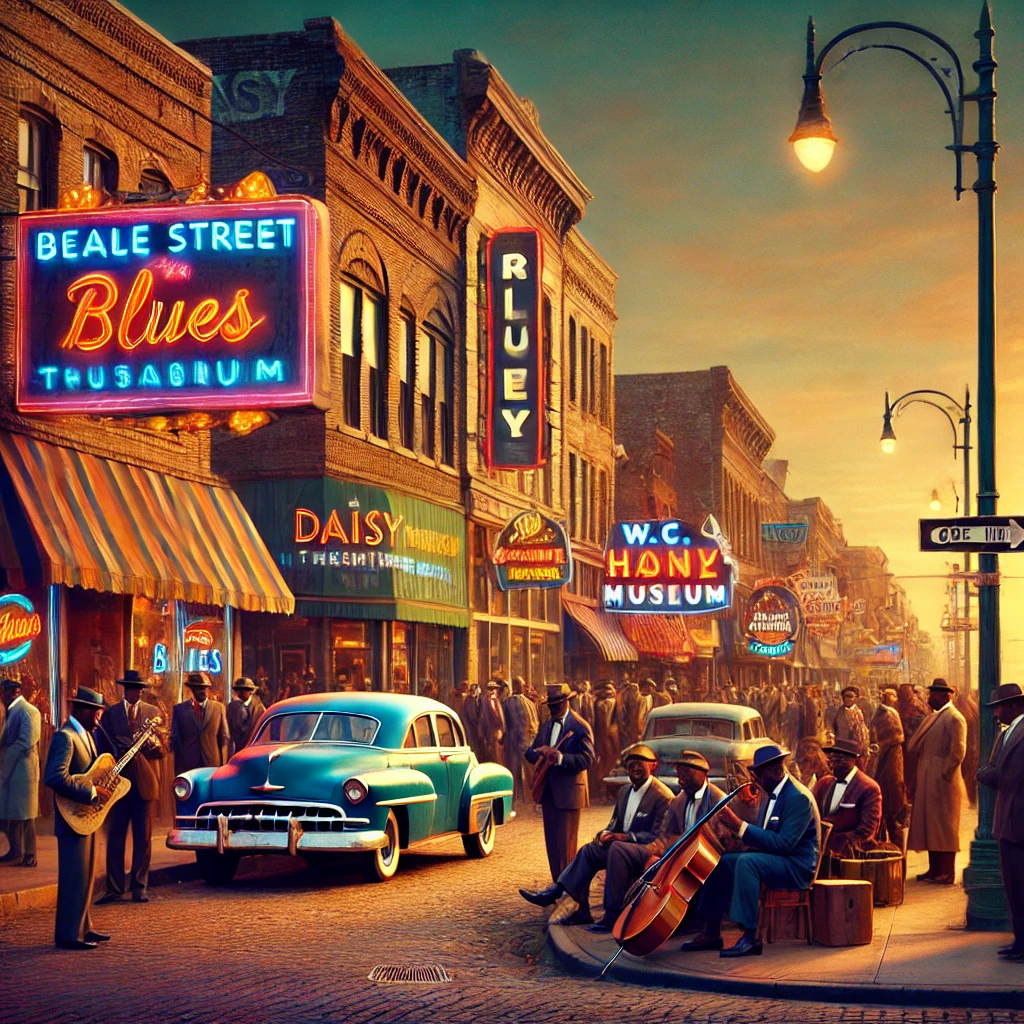
One surprising fact: within a few decades of its 1841 start, this corridor became a national symbol of music and enterprise.
The avenue began as Beale Avenue, laid out by Robertson Topp and named for Edward Fitzgerald Beale. It stretched from the Mississippi River to East Street, linking merchant wharves and an upscale suburb.

Over time, the road evolved into a vibrant hub where a determined community built churches, papers, clubs, and businesses. That growth made the street a stage for early blues and Memphis music.
By 1966 it earned National Historic Landmark status, and in 1977 Congress called it the “Home of the Blues.” A late-20th-century revival then reshaped the corridor into a top live-music and tourism destination.
Readers can find a clear chronology and deeper facts about these transformations at the city’s cultural history page. This introduction frames time, place, and the power of naming and preservation.
Key Takeaways
- Origin: Laid out in 1841 as Beale Avenue by Robertson Topp.
- Geography: Ran from the river to East Street, serving merchants and residents.
- Community: Grew into a center for commerce, music, and civic institutions.
- Recognition: Named a National Historic Landmark in 1966 and honored by Congress in 1977.
- Revival: Late-20th-century investment turned it into a premier live-music corridor.
Beale Street Memphis Black History: Origins, Geography, And Early Community Roots
beale street began as a planned corridor that tied river commerce to growing residential plots. Robertson Topp’s 1841 plan established a road that linked dockside merchants with upscale residences along the Mississippi River. The original name beale avenue reflected its early mercantile role before cultural life reshaped the path.
From Beale Avenue To Beale Street: Robertson Topp’s 1841 Vision Along The Mississippi River
The western end served ships and wholesale trade, while the eastern end developed as an affluent suburb. That split in function created steady foot traffic and customers for shops and services.
Young Men’s Brass Band And The 1860s Emergence Of Black Musicians On Beale
During the 1860s traveling musicians filled sidewalks and storefronts, making live music an everyday draw. In 1867 Sam Thomas formed the Young Men’s Brass Band, one of the first organized ensembles to claim the street as home.
“Organized bands and casual performers gave the corridor its pulse long before formal clubs appeared.”
- Spatial logic: west for trade, east for residences—this supported audience flow.
- Community roots: Reconstruction-era arrivals built churches, papers, and clubs around the street.
- Aftermath: 1870s yellow fever outbreaks reshaped land and opened space for future investment.
These early patterns of performance and commerce planted durable cultural and economic roots. For deeper archival context on early civic dynamics and investment, see early community patterns.
Black Enterprise And Civic Leadership: Robert Church, Church Park, And The Memphis Free Speech
robert church used post-1878 yellow fever vacancies to build property holdings that funded businesses and civic projects. His purchases around the river corridor made him the first black millionaire in the South and gave the local community a stable economic base.

Robert Church’s Post-Yellow Fever Investment And The First Black Millionaire In The South
He invested in commercial lots and rental properties. Those investments created jobs and capital for entrepreneurs. The strategy anchored commercial life along the avenue and attracted artists and audiences.
Church Park As A Cultural Center And Auditorium For Music, Ideas, And Politics
Church funded Church Park in 1899. Its park auditorium seated about 2,000 and hosted speakers like Booker T. Washington and Franklin D. Roosevelt. The venue linked art, politics, and civic education in one place.
Ida B. Wells, Beale Street Baptist Church, And The Memphis Free Speech
Ida Wells co-owned and edited the Memphis Free Speech on beale street. In 1889 a mob destroyed the presses for its anti-segregation reporting.
“The press on the avenue became a rallying point for reform and risked violent pushback.”
Beale Street Baptist Church, begun in 1869, stands as Tennessee’s oldest surviving african american church edifice. Together, these institutions show how commerce, faith, and journalism shaped local and national outcomes. For more on Church’s life, see the Robert Reed Church biography.
The Sound Of A City: W. C. Handy, Memphis Blues, And Beale’s Golden Music Years
music in the early 1900s moved from sidewalks into songbooks and records, giving a corridor a lasting national profile.

W. C. Handy’s Naming Legacy
W. C. Handy wrote pieces such as “Mr. Crump,” then The Memphis Blues and Beale Street Blues. These songs codified a sound and helped the lane’s name travel on sheet music and phonograph records.
Blues And Jazz Luminaries
From the 1920s to the 1940s performers like B. B. King, Louis Armstrong, memphis minnie, and Muddy Waters shaped the blues and drew audiences. Their presence professionalized venues and created clear booking patterns.
Jug Bands And Style Innovation
Jug bands used improvised instruments to craft a percussive, bottom-driven style. That ingenuity influenced arrangements, club lineups, and the evolving sound of memphis music.
Cultural Crosscurrents And Influence
Places like Pee Wee’s Saloon fused repertoire and audience energy, and a young Elvis absorbed those crosscurrents in the 1950s. Sustained creativity, touring networks, and recordings helped spread the aesthetic beyond the city.
- Legacy: Songs turned local rhythm into national identity.
- Artists: Top musicians made the corridor a creative hub.
- Diffusion: Touring and records helped the sound travel.
For a detailed timeline and context, see the detailed timeline and an analysis of commerce and music at commerce and music. These resources help explain how songs, venues, and entrepreneurs built a lasting cultural economy.
Decline, Designations, And Revival: Historic District Status To Tourism Renaissance
national register recognition arrived amid visible decline in the 1960s when many businesses closed and façades were boarded.
On May 23, 1966, the segment from Main to 4th earned National Historic Landmark status. It was added to the National Register of Historic Places on October 15, 1966.
Designation set in motion preservation measures and a formal street historic district framework. These protections guided adaptive reuse and helped secure funding for rehabilitation.
National Register Of Historic Places, National Historic Landmark, And “Home Of The Blues”
In 1973 the Beale Street Development Corporation formed and raised $5.2 million in grants. That capital, plus 1980s public–private partnerships, funded phased reopenings of clubs, restaurants, and venues.
Congress declared the corridor the “Home of the Blues” on December 15, 1977, reinforcing brand identity and boosting tourist interest in the city memphis core.
“Formal protection and targeted investment transformed boarded storefronts into a sustainable entertainment district.”
- Preservation: street historic district rules safeguarded key buildings.
- Finance: grants and partnerships converted designation into real projects.
- Outcome: steady foot traffic, festivals, and year-round venues restored cultural economy.
| Year | Designation / Action | Outcome |
|---|---|---|
| 1966 (May) | National Historic Landmark | Legal recognition; planning priority |
| 1966 (Oct) | Added to National Register of Historic Places | Access to preservation funding |
| 1973–1980s | Development Corporation and Partnerships | $5.2M grants; phased redevelopment |
| 1977 (Dec) | “Home of the Blues” Declaration | Tourist branding and cultural validation |

The combined effect of historic district controls, national register historic listings, and sustained investment secured long-term uses for venues. This strategy also honored earlier leaders whose land and business successes helped anchor the corridor’s revival and ensured the name would carry forward for future years.
Modern Beale: Festivals, Landmarks, And Businesses That Sustain The Legacy
beale street music finds its biggest spotlight each spring when the Beale Street Music Festival kicks off Memphis in May at Tom Lee Park.
The music festival draws major acts to the riverfront and funnels visitors back into nightly clubs. Year-round venues such as B. B. King’s Blues Club, Rum Boogie Cafe, Silky O’Sullivan’s, and Dyer’s keep live bookings steady.

Beale Street Music Festival, Memphis In May, And Year-Round Live Music
The street music festival functions as an economic center for the corridor and the city memphis area. Tom Lee Park’s adjacency makes the event a practical and visible part of seasonal programming.
“The festival season connects large crowds to local clubs and preserves steady work for musicians and staff.”
Street Icons And Institutions: A. Schwab’s, Hard Rock Cafe, Withers Collection, And The Orpheum
A. Schwab’s remains the oldest continuous business on the lane. Hard Rock Cafe now occupies the former Lansky Brothers location, linking hard rock and rock cafe branding to local fashion lineage from the 1900s.
The Withers Collection, the Orpheum, Rock ’n’ Soul Museum, and the W. C. Handy Home form a cultural cluster within the historic district. These sites interpret memphis music for new audiences and keep the area a tourist draw year-round.
- Continuity: Programming around the corridor echoes earlier civic assets like church park and the park auditorium tradition.
- Protection: register historic and national register listings guide stewardship of historic places while allowing adaptive reuse.
- Impact: Festivals, residencies, and nightly shows sustain foot traffic and local livelihoods.
For archival context on the corridor’s origins and early civic dynamics, see the early Beale corridor chronicle.
Conclusion
Beale Street has, over the years, stayed a vital center where commerce and culture meet.
From the original name beale avenue beside the mississippi river to modern festival seasons, the corridor shows durable reinvention.
Local african american businesses and institutions built a sustaining community framework. Music and musicians forged the blues and broadened the style that keeps the area a living cultural center.
Designation as a street historic district and placement on the national register historic roster helped protect assets while allowing adaptive programming.
The legacy of memphis minnie and other innovators lives on as preservation, programming, and governance work together to help the corridor remain authentic and welcoming. Learn more about that legacy at an unseen light on the corridor and see regional parallels at the Greenwood of the Midwest.
FAQ
What is the origin of this historic entertainment corridor and its early layout?
The corridor began as an 1841 avenue laid out by Robertson Topp near the Mississippi River. It evolved from a residential and commercial lane into a bustling promenade where river trade, hotels, and local businesses converged. Over time the route became a center for live performance and nightlife, shaped by migration, river commerce, and urban growth.
When did African American musicians first perform regularly in this district?
Black musicians organized ensembles as early as the 1860s, with brass bands and informal gatherings marking the area’s musical emergence. Groups such as young brass bands and street performers provided music for parades, social events, and riverfront crowds, laying groundwork for blues and jazz developments in the decades that followed.
Who was Robert Church and how did his investments shape the neighborhood?
Robert Church rose to prominence after the yellow fever epidemics by investing in property and commercial ventures. He became one of the South’s first documented Black millionaires, funding hotels, office buildings, and public spaces that supported Black business ownership and civic institutions. His philanthropy and landholdings anchored local economic growth.
What role did Church Park and nearby venues play in community life?
Church Park served as a gathering place for concerts, political speeches, and cultural events. It functioned as an open-air auditorium where civic leaders, entertainers, and activists addressed crowds. The park and adjacent halls fostered public debate, artistic exchange, and community organizing.
How did the press and activists like Ida B. Wells use the local platforms?
Ida B. Wells and other journalists used neighborhood institutions and nearby churches to organize, publish, and rally support for civil rights causes. Newspapers such as the Memphis Free Speech leveraged the area’s foot traffic and meeting spaces to circulate ideas and mobilize residents against injustice.
What is the connection between W. C. Handy and the musical identity of the district?
W. C. Handy popularized regional musical motifs in compositions that referenced local avenues and blues forms. His publications and performances helped codify the rhythmic and melodic traits associated with the area’s sound, influencing generations of musicians and helping to brand the city as a blues capital.
Which noted musicians are associated with the area’s musical heritage?
Prominent performers who passed through or developed their craft there include B. B. King, Louis Armstrong, Memphis Minnie, and Muddy Waters. Jug bands, blues ensembles, and street acts also contributed to a rich, evolving local style that blended rural, urban, and riverfront influences.
How did local venues and culture influence broader American music, including early rock influences?
Nightspots, saloons, and theaters showcased a mix of blues, jazz, and popular songs. Musicians performing in those venues influenced visiting artists and younger performers, contributing to stylistic crosspollination that fed into rhythm and blues and early rock ’n’ roll developments.
When and why did the area decline, and what protections were later established?
Economic shifts, urban renewal, and social changes led to decades of decline in the mid-20th century. Preservation efforts later secured historic designations such as listing on the National Register of Historic Places and recognition as a historic district, which helped catalyze rehabilitation and tourism investment.
What modern events and festivals continue the musical tradition?
Major gatherings such as the music festival during Memphis in May and other year-round live shows keep the performance culture alive. These events draw national and international artists, celebrate local talent, and underscore the area’s ongoing role as a live-music destination.
Which longstanding businesses and institutions remain landmarks for visitors?
Longstanding retailers, family-run stores, performance venues, and national brands contribute to the corridor’s mix. Notable presences include heritage shops, historic theaters like the Orpheum, music museums, and restaurants that highlight regional cuisine and live music.
How can visitors explore the neighborhood’s cultural and civil-rights sites responsibly?
Visitors should seek guided tours, museum exhibits, and interpretive markers to learn accurate historical context. Respect for memorials and active community spaces, supporting local Black-owned businesses, and attending educational programs help ensure tourism benefits residents and preserves the legacy.