
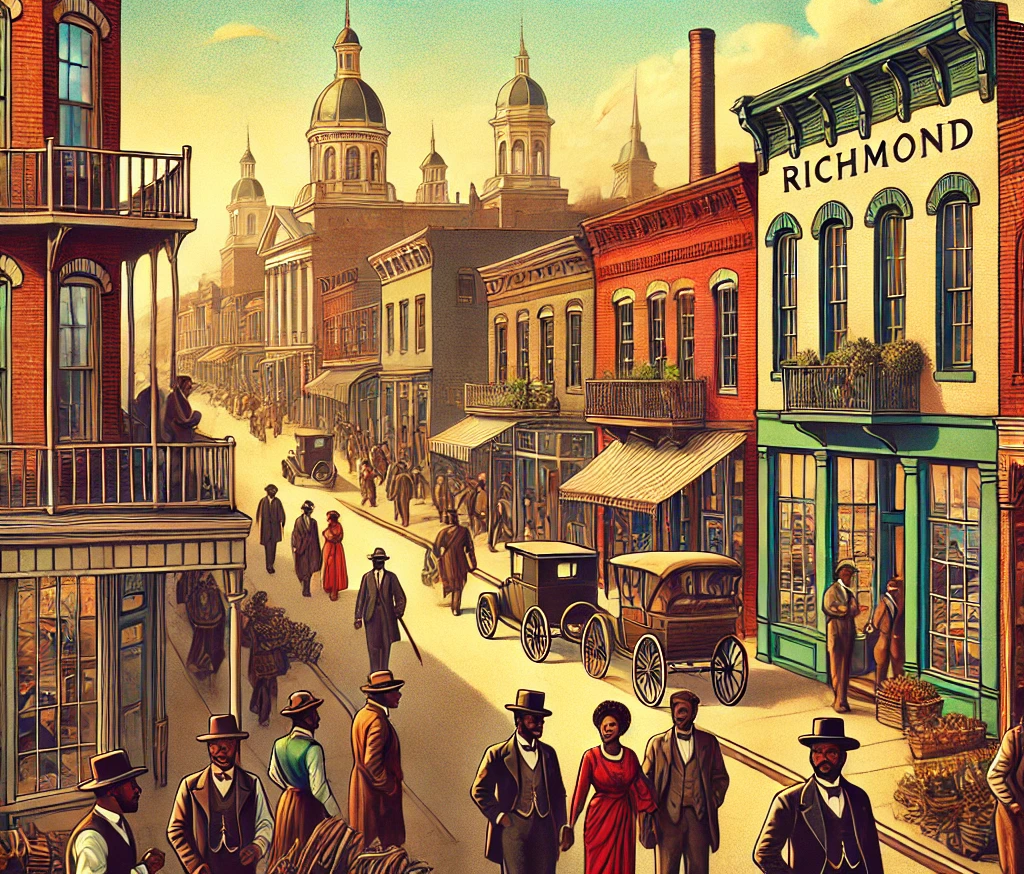
Jackson Ward Richmond Black History once hosted more than 100 African American-owned businesses and all six chartered Black banks in the city between 1889 and 1929.
That concentration made the neighborhood a national model of enterprise and social uplift. It combined banks, hotels, offices, and theaters into a compact area that powered both commerce and culture.
The first Black bank chartered in the nation, the Savings Bank of the Grand Fountain United Order of True Reformers, operated here and helped create real economic mobility. Photos of Quality Row and stately homes reinforced a visible rise in the middle class.
Venues like the Hippodrome and clubs hosted stars and nurtured local talent. Over time the area faced disinvestment, but preservation and new projects have renewed interest in its legacy.
For a deeper look at how this neighborhood shaped economic and cultural life, see a focused retrospective on historic Black Wall Street.

Key Takeaways
- The area served as a hub for African American-owned businesses and banks, driving local wealth.
- Financial institutions, like the True Reformers’ bank, anchored community growth.
- Entertainment venues created a strong cultural identity and launched major artists.
- Historic photos and homes documented social mobility and pride.
- Preservation and new initiatives aim to revive the neighborhood’s economic spirit.
Jackson Ward Richmond Black History: Origins, Geography, And Early Development
Originally called Central Wards, this part of the city grew into a compact district of homes, shops, and institutions. The name persisted even after the political ward dissolved, and the community retained a strong local identity.
From Central Wards To National Historic Landmark District
The neighborhood’s built fabric shows a clear series of architectural phases. Modest Federal cottages gave way to Greek Revival forms before the civil war. By the 1850s, Italianate details became common as development accelerated.
Location Near The Virginia State Capitol And Broad Street
Sited less than a mile from the Virginia State Capitol and just north of Broad Street, the area linked municipal power and downtown commerce. That proximity shaped who lived and worked there and influenced civic visibility.
- Early residents included German, Jewish, English, and african american families, creating diverse institutions.
- After the civil war, newly freed people joined existing residents and helped organize businesses and schools.
- Armstrong High School’s site later housed adult career education, while Abner Clay Park provided recreation and community space.
The 1978 designation as a National Historic Landmark recognized both architecture and the district’s role in urban life. This early development set the stage for later commercial and cultural growth.
Black Wall Street Of The South: Enterprise, Banking, And Middle-Class Growth
A tightly knit network of enterprises and savings institutions shaped the neighborhood’s economic life and fueled middle‑class growth in the early 20th century.

Maggie L. Walker And St. Luke’s Penny Savings Bank
Maggie Walker became the first woman to charter and lead an American bank when St. Luke’s Penny Savings opened its headquarters at First and Marshall in 1910.
The bank offered mortgages, savings clubs, and financial lessons that let families buy a home and build equity.
True Reformers’ Savings Bank And A Network Of Black-Owned Banks
The Savings Bank of the Grand Fountain United Order of True Reformers was the first bank chartered by African Americans in the country.
Along with five other chartered banks, it created local credit channels that financed shops, building repairs, and new businesses.
Entrepreneurship In Practice: Law, Insurance, Pharmacies, And Funeral Homes
- Law offices formalized deeds and contracts that protected gains.
- Insurance firms and pharmacies provided essential services and jobs.
- Funeral homes offered dignified care and sustained family-owned business legacies.
George O. Brown’s Photography Studio And Wealth-Building Through Homeownership
Photographer George O. Brown documented families and enterprise from the 1890s into the 1960s, reinforcing pride and patronage for local businesses.
Capital circulation in this corridor funded apprenticeships, boosted household income, and strengthened the building stock for the century ahead.
For a detailed economic perspective, see a focused study on economic history.
Architecture And Urban Form: Quality Row, Leigh Street, And Charles T. Russell
The built environment along Leigh Street and nearby blocks records a century of evolving styles and social standing. Streetscape details — porches, cornices, and ironwork — make the district legible at a glance.

Greek Revival, Italianate, And Late Victorian Styles Across The District
The area blends Greek Revival symmetry, Italianate ornament, and Late Victorian massing. This mix made the streets feel both ordered and richly detailed.
Quality Row On East Leigh Street And The Elite
Quality Row on East Leigh Street showcased prominent homes and signaled wealth and civic investment. The corridor included Maggie L. Walker’s residence; researchers can find documentation in the Maggie Walker nomination.
Charles T. Russell’s Multipurpose Buildings And National Influence
Charles T. Russell designed mixed-use buildings with shops below and residences above. His 1910 bank and later projects influenced architects beyond the city and improved local housing and commerce.
Preservation And Adaptive Reuse: The Russell-Designed St. James Street Mansion
The saved 508 St. James Street mansion shows how careful restoration can yield housing while keeping historic character. Rehabilitation projects used tax credits and modern systems to stabilize façades and repair interiors.
Faith, Community, And Institutions: Churches, Schools, And Civic Life
Churches, schools, and parks created a web of support that helped residents navigate daily life and civic challenges.

Sixth Mount Zion Baptist Church And Rev. John Jasper
Sixth Mount Zion Baptist Church, founded in 1867 by Rev. John Jasper, grew into a 1,400-seat sanctuary. The church shaped spiritual life and civic action.
Preaching and institution-building after the Civil War gave people a strong public voice.
Third Street Bethel, Hood Temple AME, And Ebenezer Baptist Church
Other congregations—Third Street Bethel AME, Hood Temple AME, and Ebenezer Baptist Church—offered schooling and social services.
These churches doubled as meeting halls for voter drives, clinics, and mutual aid programs.
Armstrong High School, Abner Clay Park, And Neighborhood Gathering Spaces
The former Armstrong High School site now houses the Adult Career Development Center, continuing education and workforce training.
Abner Clay Park functioned as a communal backyard, hosting sports, bandstand events, and gatherings that tied the neighborhood together.
- Social safety net: Faith institutions helped stabilize housing and offered emergency aid.
- Leadership: Pastors and lay leaders mentored youth and advocated before city officials.
- Memory: Churches preserved records and stories that document local achievements in black history.
Culture And Nightlife: The Hippodrome, “The Deuce,” And Harlem Of The South
A lively after-dark circuit on The Deuce made the area a celebrated hub for music and social life. The Hippodrome hosted icons—Cab Calloway, Ella Fitzgerald, James Brown—and helped earn the moniker Harlem South.

Second Street Entertainment: Cab Calloway, Ella Fitzgerald, And James Brown
The Deuce drew touring acts and packed houses. Photos and playbills from the era document a golden series of performances that linked artists to local theaters, clubs, and hotels.
Eggleston Hotel And Black Travel Networks
The Eggleston Hotel provided dignified lodging for performers and travelers when many city hotels refused service. Its presence connected the district to wider travel networks across the country.
Contemporary Dining And Arts: The Hippodrome, Mama J’s, And First Fridays
Today the Hippodrome operates as a multifunctional venue. Modern restaurants—from Mama J’s to Cheddar Jackson—continue the hospitality tradition and draw new audiences.
“The district’s stages and cafés created a shared public life where art, business, and pride met.”
| Era | Key Venues | Lasting Impact |
|---|---|---|
| Early 20th Century | Hippodrome, The Deuce clubs | National acts; cultural prestige |
| Mid Century | Eggleston Hotel, lounges | Safe lodging; touring network |
| Present | Restored Hippodrome, restaurants, First Fridays | Revived arts economy; new visitors |
Civil Rights, Urban Renewal, And Revival: Displacement, Resistance, And Recovery
Mid‑century redevelopment reshaped the neighborhood’s streets, replacing homes and shops with large housing blocks and a new expressway corridor.

Housing Authority Plans, Gilpin Court, And Expressway Construction
The city’s housing authority launched plans in 1941, 1956, and 1961 that targeted large parcels for clearance and new housing.
Gilpin Court replaced roughly 200 houses with 297 units, but few former residents returned. The Richmond‑Petersburg Turnpike later destroyed over 1,000 homes and blocked 31 streets.
Rerouting I‑95 To Save Sixth Mount Zion—Community Advocacy In Action
Organized advocates pressed officials to alter the highway’s path to spare Sixth Mount Zion Baptist Church.
The reroute preserved the sanctuary but the congregation still lost about 1,000 members, showing both gain and pain from infrastructure decisions.
Legal Leadership: Hill, Martin, Robinson, And The Brown v. Board Era
Civil rights attorneys linked to the district—Oliver Hill, Martin A. Martin, and Spottswood W. Robinson III—used law and newspapers to press claims for equity.
Their work helped advance cases that culminated in Brown v. Board and other reforms affecting schooling and public policy.
Preservation, Tax Credits, And Modern Initiatives Like The JXN Project
Preservation policy and historic tax credits in the 1980s enabled restoration of key buildings, including the Leigh Street Armory’s conversion into the museum in 2016.
The JXN Project (2021) paired events and storytelling to surface lost narratives and guide new development with resident input.
“The district’s recovery came through law, faith institutions like Sixth Mount, and the persistence of residents who kept memory and place alive.”
- The housing authority’s plans concentrated public housing and displaced residents.
- Highway construction severed links to downtown commerce and services.
- Advocacy saved sacred buildings but could not fully prevent community loss.
For more context on the neighborhood’s arc, see a detailed overview at Jackson Ward.
Conclusion
Adaptive reuse and grassroots leadership reunited historic assets with modern needs, ensuring the district’s legacy stayed visible and useful.
The 1978 National Historic Landmark designation, the revived Hippodrome, the Maggie L. Walker House, and the Leigh Street Armory conversion (2016) all anchor public memory.
Contemporary programming like First Fridays and organizations such as the jackson ward Collective (founded 2020) help entrepreneurs and residents connect past business models with new ventures.
Preservation, cultural events, and inclusive planning have kept foot traffic, supported housing options, and protected buildings so people can learn and thrive in this neighborhood.
FAQ
What makes this neighborhood historically significant?
The district earned recognition for its concentration of African American entrepreneurship, professional institutions, and cultural centers. It became a national historic landmark for its role as a commercial and civic hub where banks, churches, schools, and entertainment venues fostered middle-class growth and community resilience.
Where is the district located relative to the state capitol and major streets?
The neighborhood sits just north of the Virginia State Capitol and close to Broad Street. Key corridors like Leigh Street and East Leigh functioned as commercial and residential spines, connecting churches, businesses, and historic homes to downtown Richmond.
Who was Maggie L. Walker and why is she important?
Maggie L. Walker founded St. Luke’s Penny Savings Bank and led the Independent Order of St. Luke. She used banking, publishing, and cooperative strategies to expand economic opportunity for Black residents, making her a central figure in the area’s growth as a center of enterprise.
What kinds of businesses and professions thrived in the neighborhood?
The area supported a diverse professional ecosystem: banks, law offices, insurance firms, pharmacies, funeral homes, barbershops, and photography studios. These businesses created a robust local economy often compared to “Black Wall Street” in scale and ambition.
How did architecture reflect the community’s character?
Architectural styles range from Greek Revival and Italianate to Late Victorian. Prominent residential rows, such as Quality Row on East Leigh Street, and multifunctional commercial blocks designed by Charles T. Russell showcased both elite residences and adaptive mixed-use buildings.
Which churches and civic institutions anchored neighborhood life?
Churches like Sixth Mount Zion Baptist and Mount Zion Baptist, along with Hood Temple AME and Ebenezer Baptist, served spiritual and civic roles. Schools such as Armstrong High School and communal sites like Abner Clay Park provided education and gathering space for residents.
What role did entertainment and nightlife play in the district’s culture?
The district was a regional entertainment center known as the “Harlem of the South.” Venues like the Hippodrome and clubs along Second Street hosted national performers — from Cab Calloway to James Brown — and supported a lively nightlife and hospitality network including boarding hotels and Black travel resources.
How did mid‑20th century urban renewal affect the community?
Federal and local urban renewal projects, public housing developments like Gilpin Court, and highway construction caused displacement and altered neighborhood fabric. Community advocacy, including efforts to reroute I‑95, exemplified resistance and shaped later preservation strategies.
What preservation efforts and redevelopment projects exist today?
Preservation initiatives use tax credits and adaptive reuse to restore historic buildings, convert former commercial blocks into housing and arts venues, and support projects such as the JXN initiative that aim to revive commercial corridors while honoring cultural legacy.
How did local legal and civic leaders contribute to civil rights and advocacy?
Attorneys and civic leaders from the area — working in concert with statewide movements — advanced litigation, civic organizing, and political advocacy. Their leadership linked neighborhood struggles to broader civil rights wins and legal reforms in education and housing.
Are there sites that interpret the neighborhood’s past for visitors today?
Several restored churches, museum exhibits, historic homes, and guided walking tours highlight the district’s architectural landmarks, business history, and cultural institutions. These resources provide context for residents and visitors interested in the area’s legacy.
How did homeownership and local finance support wealth building?
Local institutions, including community banks, promoted savings, small business credit, and mortgages that enabled homeownership. This financial infrastructure underpinned familial wealth, property investment, and stability for multiple generations.
What culinary and cultural destinations remain important now?
Longstanding restaurants and newer dining spots, arts venues, and events like First Fridays play a role in the neighborhood’s contemporary cultural life. Places such as the Hippodrome or community eateries anchor ongoing cultural and economic activity.